
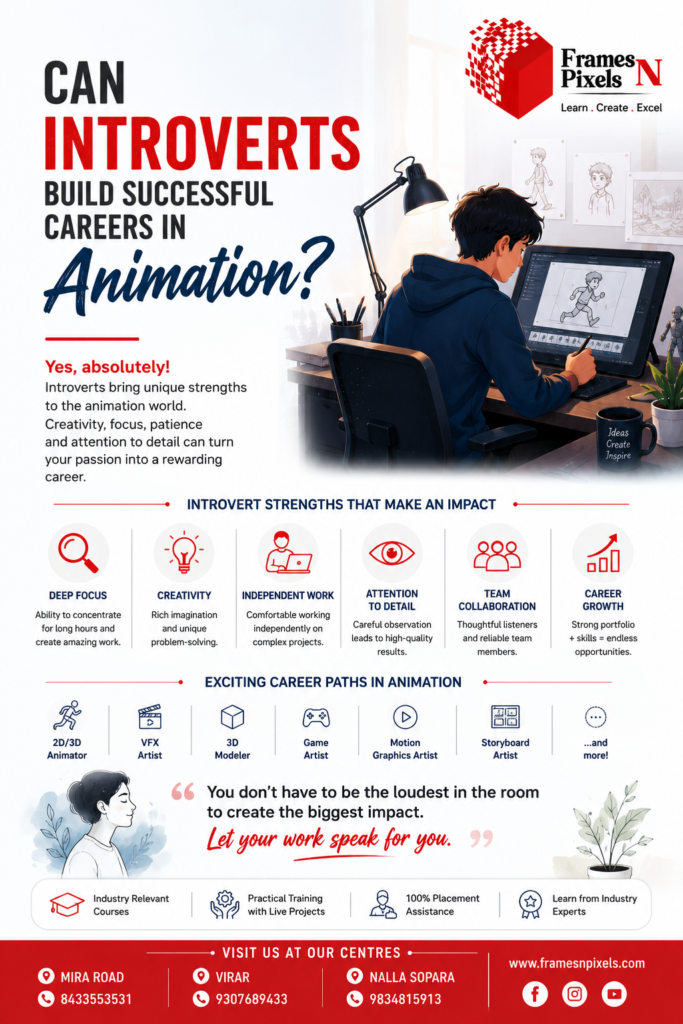
Can Introverts Build Successful Careers in Animation?
Can introverted students succeed in animation? Discover why creativity, technical skills, teamwork, and a strong portfolio can help introverts build rewarding careers in animation and related fields.
Can Introverts Build Successful Careers in Animation?
When students think about a career in animation, they sometimes imagine confident people presenting ideas in meetings, working in large teams, or constantly communicating with clients.
This can make introverted students wonder:
“Is animation the right career for someone like me?”
The answer is yes.
In fact, many qualities commonly associated with introverts—such as observation, concentration, patience, creativity, and the ability to work independently—can be valuable in the animation industry.
Animation is not one single job. It is a large field with many different roles, and not every role requires constant public speaking or social interaction.
What matters most is your ability to create, learn, collaborate, and communicate professionally.
What Does It Mean to Be an Introvert?
Being an introvert does not necessarily mean being shy or unable to communicate.
Introversion is more about how a person prefers to use their energy. Some people enjoy large social gatherings and frequent interaction, while others prefer quieter environments and smaller groups.
An introverted student may enjoy:
- Working independently
- Spending time developing ideas
- Focusing deeply on a task
- Observing people and surroundings
- Thinking carefully before speaking
- Exploring creative interests
These qualities can be useful in many creative professions.
Being an introvert is not a weakness. It is simply a different personality style.
Animation Offers Many Different Career Paths
One of the biggest advantages of the animation industry is its variety.
A student interested in animation does not necessarily have to become a character animator.
There are career opportunities in:
- 2D Animation
- 3D Animation
- VFX
- 3D Modeling
- Character Design
- Texturing
- Lighting
- Rigging
- Motion Graphics
- Game Art
- Graphic Design
- Video Editing
- Compositing
- Storyboarding
- Environment Design
Different roles require different combinations of creativity, technical ability, and communication.
An introverted student who enjoys detailed work might find 3D modeling or texturing appealing. Someone who enjoys visual storytelling may prefer animation or storyboarding. A student interested in technology might explore VFX, compositing, or technical art.
The key is to discover where your personality and interests fit best.
Creativity Often Needs Concentration
Good creative work rarely happens in a constant state of distraction.
Artists and designers often spend hours refining a character, improving a composition, adjusting lighting, or solving a technical problem.
This requires patience and concentration.
Many introverted students are comfortable spending extended periods working deeply on a project. This can become an advantage when developing complex creative skills.
Animation is a profession where the quality of your work matters greatly.
Your ability to focus and produce excellent results can be more important than being the most talkative person in the room.
Your Portfolio Can Speak for You
One of the most attractive aspects of creative careers is the importance of a portfolio.
When applying for many animation and design jobs, employers want to see what you can actually do.
Your portfolio can demonstrate:
- Your technical skills
- Your creativity
- Your understanding of design
- Your ability to solve problems
- Your attention to detail
- Your personal style
A strong portfolio can communicate your abilities even before you say a word.
This does not mean communication is unimportant. It simply means that creative professionals have a tangible way to demonstrate their capabilities.
For introverted students, this can be encouraging.
Your work can become one of your strongest forms of self-expression.
But Communication Still Matters
There is one important point to remember.
Being introverted does not mean you can avoid communication completely.
Animation is usually a collaborative profession. A project may involve artists, animators, designers, directors, producers, writers, editors, and technical teams.
You will need to:
- Understand instructions
- Ask questions
- Receive feedback
- Explain your ideas
- Participate in team discussions
- Meet deadlines
- Communicate with colleagues
The good news is that communication is a skill that can be learned.
You do not have to become the loudest person in the room.
You simply need to become comfortable expressing your ideas clearly and professionally.
Introverts Can Develop Their Communication Skills
A student who is naturally quiet can gradually become a confident communicator.
Start with small steps:
Participate in Discussions
Share one idea during a group discussion instead of trying to dominate the conversation.
Present Your Work
Explain your creative decisions to classmates or teachers.
Ask Questions
Don’t hesitate to ask for clarification when you don’t understand something.
Practice Public Speaking
Short presentations can gradually build confidence.
Learn Professional Communication
Writing clear emails and messages is an important skill for both office jobs and freelancing.
The goal isn’t to change your personality.
The goal is to develop enough communication skills to work effectively with others.
Freelancing Can Offer Flexibility
Animation and graphic design also offer opportunities for freelancing.
Freelancers can work with clients on:
- Animation projects
- Motion graphics
- Video editing
- 3D visualization
- Graphic design
- VFX
- Game assets
Much of the communication can take place through email, messaging, project management platforms, and video calls.
This can provide a comfortable working environment for people who prefer more independence.
However, freelancing also requires communication, negotiation, client management, and networking.
So while introverts may appreciate the flexibility of freelancing, they still need professional interaction skills.
Working in Teams Is Still Part of the Job
It is important not to assume that animation is a completely solitary career.
Large projects are almost always collaborative.
For example, an animated film may involve hundreds of professionals working across different departments.
A VFX project may involve artists, compositors, supervisors, and technical teams.
A game may require programmers, designers, animators, artists, writers, and sound professionals.
The ability to collaborate is therefore essential.
But collaboration does not require everyone to have the same personality.
A quiet person can be an excellent team member.
Listening carefully, respecting others’ ideas, meeting deadlines, and delivering high-quality work are all valuable contributions.
Introverts May Have Some Natural Advantages
While every individual is different, some qualities often associated with introversion can be helpful in creative careers.
Observation
Animation requires observing movement, expressions, people, and the world around us.
Patience
Creating high-quality animation can take considerable time and attention to detail.
Deep Focus
Complex software and creative projects often require sustained concentration.
Independent Learning
Creative professionals frequently need to learn new software and techniques on their own.
Thoughtful Creativity
Some people prefer to think deeply before developing an idea. This can be useful during the creative process.
These qualities don’t guarantee success, but they can certainly become strengths.
Don’t Let Personality Decide Your Career
Students sometimes reject careers because they believe they don’t have the “right personality.”
A quiet student may think:
“I’m not confident enough.”
A student who doesn’t enjoy socialising may think:
“I won’t fit into the industry.”
These assumptions can unnecessarily limit career choices.
A career should be chosen based on a combination of:
- Interest
- Aptitude
- Skills
- Personality
- Career goals
- Willingness to learn
If you genuinely enjoy animation, design, storytelling, or technology, being introverted should not stop you from exploring the field.
How Introverted Students Can Prepare for an Animation Career
If you are an introvert interested in animation, focus on developing both technical and interpersonal skills.
Build Strong Technical Skills
Learn relevant software and understand the fundamentals of animation, design, VFX, or 3D production.
Create a Portfolio
Work on personal and practical projects that demonstrate your abilities.
Practice Communication
Learn to explain your work clearly and accept constructive feedback.
Participate in Team Projects
Collaborative projects can help you become comfortable working with others.
Develop Confidence Gradually
You don’t need to transform your personality overnight. Build confidence through small, regular experiences.
Learn Continuously
The creative industry changes rapidly. Keep learning new tools, techniques, and technologies, including AI-assisted workflows.
The Future Belongs to Different Kinds of Creators
The animation industry needs different personalities.
It needs imaginative storytellers, technically skilled artists, thoughtful designers, problem-solvers, team leaders, and creative directors.
Not everyone has to be outgoing.
Some professionals may prefer working quietly on a character. Others may enjoy leading a large production team. Both can have valuable roles in the same industry.
The important thing is to understand yourself and develop the skills needed for the career you choose.
Summary
Can introverts build successful careers in animation? Absolutely.
Your personality does not determine your potential.
Animation is a diverse industry with opportunities in 2D and 3D animation, VFX, graphic design, motion graphics, gaming, 3D modeling, compositing, and many other areas.
If you are naturally introverted, your ability to concentrate, observe, think deeply, and work independently can become valuable strengths.
At the same time, don’t use introversion as a reason to avoid developing communication skills. The most successful creative professionals combine technical expertise, creativity, collaboration, and professional communication.
You don’t have to become someone you’re not.
Find courses of Frames and Pixels at https://www.arenavirar.con
You simply need to become the best version of yourself—and let your work speak for your talent.