
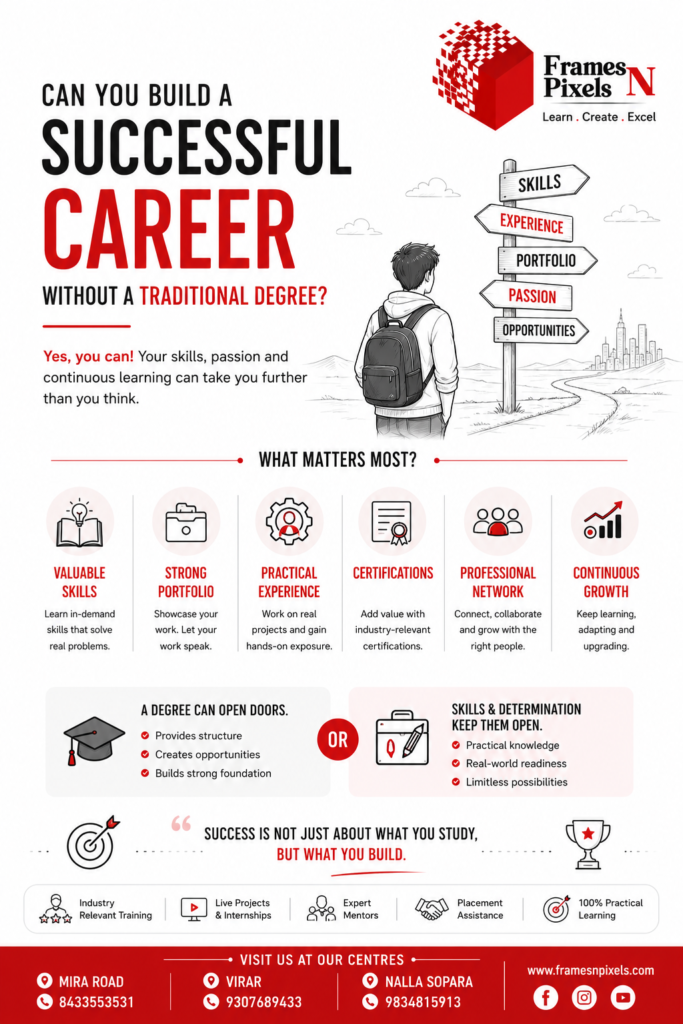
For generations, students have been told that the traditional path to a successful career is simple:
Finish school → Earn a degree → Get a job → Build a career.
But the world of work is changing.
Today, students can learn skills online, complete professional certifications, work on real projects, build portfolios, freelance for international clients, and even start businesses without following the traditional university route.
This raises an important question:
Can you really build a successful career without a traditional degree?
The answer is yes—but there is an important qualification.
A degree is not always essential for every career, but skills, knowledge, experience, discipline, and continuous learning are essential for almost every career.
For many students, the smartest approach may not be choosing between a degree and skills, but understanding when each is valuable.
A Degree Is Not the Only Measure of Ability
A traditional degree demonstrates that a person has completed a structured programme of education.
It can provide:
- Academic knowledge
- Structured learning
- Access to teachers and mentors
- Peer networks
- Opportunities for internships
- Eligibility for higher education
- Access to certain professions
However, a degree does not automatically guarantee that a graduate can perform a job.
Consider two candidates applying for a creative position.
Candidate A has a degree but has never completed a real project.
Candidate B has no traditional degree but has completed several professional projects and has a strong portfolio.
Depending on the job, the employer may be more interested in Candidate B’s demonstrated ability.
This is particularly true in fields such as:
- Graphic Design
- Animation
- VFX
- Video Editing
- Digital Marketing
- Web Development
- Photography
- Content Creation
- UI/UX Design
- 3D Design
In these industries, employers often want to see what you can actually create.
The Rise of the Skills-Based Career
Many industries are becoming increasingly skills-focused.
Employers want people who can solve problems, use technology, communicate effectively, and contribute to real projects.
This has increased the importance of:
Skills + Experience + Portfolio + Professional Attitude
For a creative professional, a portfolio can sometimes be more persuasive than a list of academic marks.
For a programmer, employers may look at projects and coding ability.
For a digital marketer, they may be interested in campaign results.
For a freelancer, clients are usually interested in previous work and the ability to deliver.
The evidence of your ability becomes extremely important.
Creative Careers Are a Good Example
Consider the animation and VFX industry.
If you want to become an animator, employers may look at:
- Demo reels
- Animation quality
- Understanding of movement
- Software skills
- Storytelling
- Creativity
- Teamwork
Similarly, a graphic designer may be evaluated based on:
- Portfolio quality
- Typography
- Colour understanding
- Layout
- Branding
- Digital design skills
A degree can certainly be useful, but it is unlikely to compensate for a complete lack of practical ability.
In creative careers, your work often speaks louder than your certificate.
But Does That Mean Degrees Are Useless?
Absolutely not.
This is where students and parents need to be careful.
Saying that a degree is not always necessary is very different from saying that education is unnecessary.
A degree can provide significant advantages.
For some professions, it is essential.
If you want to become a:
- Doctor
- Lawyer
- Engineer in certain regulated roles
- Chartered professional
- Teacher in many formal education systems
- Research scientist
you may need specific academic qualifications and professional accreditation.
A degree can also help with:
- Postgraduate education
- International study
- Certain job eligibility requirements
- Immigration or visa processes in some situations
- Career changes later in life
- Management and leadership opportunities
Therefore, students should not reject higher education simply because some careers can be entered without a degree.
The right question is:
“What does my chosen career require?”
The Best of Both Worlds: Degree + Skills
For many students, the ideal combination may be:
A recognised degree + industry-relevant skills + practical experience + portfolio
Imagine a student who completes a degree in a creative discipline while simultaneously learning professional software, participating in live projects, completing internships, and developing a strong portfolio.
That student may have several advantages.
The degree provides formal academic recognition.
The skills provide practical employability.
The portfolio demonstrates ability.
The project experience demonstrates readiness for professional work.
This combination can create a stronger foundation than relying on any one of these elements alone.
What If You Don’t Have a Degree?
If you have decided not to pursue a traditional degree—or have already left formal education—your career is not necessarily over.
You need to take a more deliberate approach to building credibility.
Focus on five areas.
1. Develop Valuable Skills
Choose skills that have real demand in the market.
Don’t simply learn a tool because it is popular.
Understand what businesses and employers actually need.
2. Build a Portfolio
Create projects that demonstrate what you can do.
If you are a designer, show designs.
If you are an animator, create animation.
If you are a video editor, produce edited videos.
Your portfolio should answer one question:
“Why should someone hire me?”
3. Gain Real-World Experience
Experience can come from many sources.
You can work on:
- Internships
- Freelance projects
- Student projects
- Personal projects
- Volunteering
- Small business assignments
- Start-up projects
Even small projects can teach you about deadlines, clients, revisions, teamwork, and professional expectations.
4. Earn Relevant Certifications
Professional certifications can sometimes help demonstrate knowledge in specific areas.
They are particularly useful when combined with practical experience.
However, don’t collect certificates simply to fill your resume.
A certificate should represent a skill you can actually apply.
5. Build Your Professional Network
Many opportunities come through people.
Connect with:
- Industry professionals
- Teachers
- Mentors
- Alumni
- Employers
- Freelancers
- Creative communities
Attend workshops, conferences, exhibitions, and industry events.
Sometimes, the person who recommends you for your first opportunity can be as important as the qualification on your resume.
Freelancing Has Changed the Career Landscape
Freelancing has made it possible for skilled individuals to work independently without following a traditional employment path.
A talented professional can now work with clients across India and internationally.
Freelancers can offer services in:
- Graphic Design
- Animation
- VFX
- 3D Visualisation
- Video Editing
- Web Development
- Digital Marketing
- Content Creation
Clients often care about:
Can you do the work?
Can you deliver on time?
Can you communicate professionally?
Can you solve my problem?
However, freelancing is not an easy shortcut.
Successful freelancers need to develop skills in:
- Client communication
- Pricing
- Negotiation
- Project management
- Marketing
- Financial management
- Time management
A person without a degree can certainly succeed as a freelancer, but they still need to become a professional.
The Internet Has Changed How We Learn
Today, knowledge is more accessible than ever.
Students can learn from:
- Online courses
- Tutorials
- Professional communities
- Industry webinars
- Digital libraries
- Workshops
- Mentorship programmes
But access to information is not the same as developing expertise.
Watching 100 tutorials does not make you a professional.
Practice does.
A student who learns a skill and immediately applies it through projects will generally progress faster than someone who only consumes educational content.
This is why learning by doing is so important.
AI Is Changing the Meaning of Skills
Artificial Intelligence is creating another major shift in the job market.
AI can now assist with:
- Writing
- Image generation
- Design
- Video production
- Coding
- Research
- Data analysis
This does not mean that human skills are becoming irrelevant.
Instead, the nature of valuable skills is changing.
Professionals increasingly need to know:
- How to use AI tools
- How to evaluate AI output
- How to think critically
- How to solve problems
- How to communicate
- How to develop creative ideas
- How to apply domain knowledge
The future may favour people who combine technical skills, human creativity, critical thinking, and AI literacy.
What Should Parents Tell Their Children?
Parents naturally want their children to have a secure future.
For many families, a traditional degree represents stability.
That is understandable.
However, career decisions should be based on the student’s interests, abilities, and the requirements of the chosen profession.
Instead of asking:
“Degree or no degree?”
Ask:
“What combination of education and skills will give my child the best future?”
For some careers, the answer will be a professional degree.
For others, it may be a specialised qualification combined with practical training.
For creative careers, it may be a degree combined with professional skills and a strong portfolio.
The goal should be employability and long-term growth, not simply collecting certificates.
The Future of Careers Will Be More Flexible
The traditional career path is no longer the only path.
A person may:
- Study at university
- Learn professional skills
- Start freelancing
- Join a company
- Build a side business
- Start a company
- Return to education later
Careers are becoming more flexible and less linear.
However, flexibility also comes with responsibility.
You must continuously update your skills.
The qualification that was sufficient five years ago may not be enough today.
The software you learned yesterday may be replaced tomorrow.
The professionals who continue learning will be better prepared for change.
So, Can You Build a Successful Career Without a Traditional Degree?
Yes, you can.
But you cannot build a successful career without learning.
You need knowledge.
You need skills.
You need experience.
You need discipline.
You need the ability to adapt.
You need to demonstrate what you can do.
And you need to keep improving.
For some careers, a traditional degree remains essential.
For others, employers may place greater emphasis on skills and experience.
And for many students, the strongest path may be to combine both.
A degree can open doors.
Skills can help you get hired.
Experience can help you grow.
A portfolio can prove your ability.
Continuous learning can keep you relevant.
The real question is not whether you need a traditional degree.
The real question is:
“What do I need to learn and demonstrate to build the career I want?”
Once you answer that question, you can create a career path that combines education, practical skills, experience, and continuous learning—whether your journey follows a traditional route or takes a different direction. Learn the courses which can help in your career at https://www.arenavirar.com
References
- World Economic Forum – The Future of Jobs Report 2025
Discusses the growing importance of skills, reskilling, upskilling, and skills-based hiring in the changing global job market.
World Economic Forum – Future of Jobs Report 2025 - World Economic Forum – Workforce Strategies
Provides data on employers’ use of work experience, skills assessments, and university degrees when evaluating candidates. It highlights the growing role of practical experience and skills-based hiring.
World Economic Forum – Workforce Strategies - World Economic Forum – The Future of Jobs in India
Examines India’s changing employment landscape and notes that some companies are expanding talent pools by removing degree requirements and offering apprenticeships and training.
World Economic Forum – The Future of Jobs in India - OECD – Skills-First Readiness and Adoption Index
Explains the concept of skills-first approaches, which prioritise demonstrated skills and experience alongside or instead of formal qualifications in hiring and workforce development.
OECD – Skills-First Readiness and Adoption Index - U.S. Bureau of Labor Statistics – Education Pays
Provides data showing the relationship between educational attainment, earnings, and unemployment. This is a useful counterpoint to the skills-first argument and supports the article’s conclusion that education and skills can both have significant career value.
U.S. Bureau of Labor Statistics – Education Pays - World Economic Forum – Skills-Based Hiring
Explores how skills-based hiring can help employers identify talent based on capabilities and adaptability rather than relying solely on traditional qualifications.
World Economic Forum – Skills-Based Hiring