
Discover the steps to grow from a beginner VFX artist to a supervisor.
Introductions
The world of Visual Effects (VFX) has transformed the way we experience movies, web series, advertisements, video games, and digital content. From creating realistic explosions to designing imaginary worlds, VFX artists combine creativity and technology to bring incredible visual ideas to life.
For students and aspiring creative professionals, VFX offers opportunities to develop specialised skills and gradually progress into senior creative and leadership roles. However, building a successful career in this industry is not just about learning software. It requires practical experience, artistic understanding, problem-solving abilities, teamwork, and continuous learning.
One of the most exciting career goals for an experienced VFX professional is becoming a VFX Supervisor—a role that combines technical expertise, creative decision-making, and leadership.
In this blog, we will explore the complete VFX career journey, from beginner to supervisor, the skills required at every stage, and how aspiring artists can prepare for long-term career growth.
What Is VFX?
Visual Effects, commonly known as VFX, involves creating or enhancing visual elements using digital tools and techniques. It allows filmmakers and content creators to produce scenes that may be difficult, expensive, unsafe, or impossible to capture in real life.
VFX is widely used in:
- Movies and television productions
- OTT platforms and web series
- Advertising and commercial videos
- Video games and cinematic trailers
- Music videos and promotional content
- Virtual production and digital environments
VFX professionals work in different departments, including compositing, rotoscoping, matchmoving, 3D modelling, lighting, and effects simulation. Each department contributes to the final visual quality of a production.
Understanding these different roles is an important first step towards planning your career.
Understanding the VFX Career Path
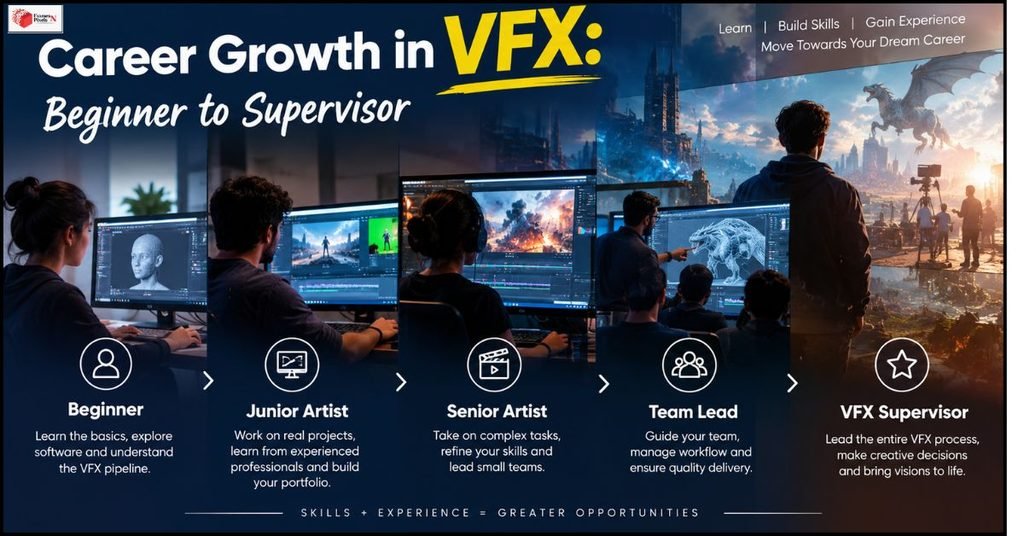
A career in VFX generally progresses from entry-level production work to specialised artistic roles, senior positions, team leadership, and eventually supervision. The exact job titles and progression vary between studios and departments.
Here is a simplified overview of the career journey.
1. Beginner or VFX Trainee
Every professional journey begins with learning the fundamentals. Beginners may start with structured training, personal projects, internships, or trainee opportunities.
At this stage, focus on understanding the basics of visual effects and developing confidence with digital tools.
What you should learn:
- Fundamentals of compositing and image manipulation
- Basic understanding of lighting, shadows, perspective, and colour
- Introduction to 2D and 3D workflows
- Basic rotoscoping, tracking, and cleanup techniques
- File management and project organisation
- How to follow instructions and incorporate feedback
Beginners should practise regularly and create small projects that demonstrate their progress. Instead of trying to master every software package, focus on building a strong foundation.
2. Junior VFX Artist
After developing foundational skills, you can start applying for suitable junior roles or internships.
Junior artists generally work on clearly defined production tasks under the guidance of experienced artists or supervisors. Depending on the department, their responsibilities may include cleaning footage, creating mattes, tracking camera movement, preparing assets, or assisting with compositing.
Skills to develop at this stage:
- Accuracy and attention to detail
- Familiarity with department-specific software
- Ability to follow production instructions
- Meeting deadlines and quality requirements
- Accepting feedback professionally
- Understanding the basic production pipeline
The goal is to become reliable. Delivering consistent work, communicating clearly, and learning from corrections can help you build trust within a team.
3. Mid-Level VFX Artist
With experience, artists may progress into intermediate roles where they handle more complex shots and solve problems with greater independence.
At this stage, you are expected to understand not only how to complete a task but also why a particular technique is suitable for the shot.
For example, a compositor may need to match lighting and colour between multiple elements, while an FX artist may need to adjust a simulation to achieve a specific visual result.
Focus areas for career growth:
- Improving technical accuracy and creative quality
- Troubleshooting problems independently
- Working efficiently on complex shots
- Understanding how your work affects other departments
- Communicating clearly with teammates
- Helping junior artists when appropriate
To move forward, review your completed projects and identify recurring mistakes. Learning to solve problems without constant supervision is an important step towards senior responsibilities.
4. Senior VFX Artist
Senior artists have extensive experience in their specialisation and can handle challenging production requirements.
They are often trusted with important shots, complex technical problems, and work that requires a high level of creative judgement. Depending on the studio, they may also help review work, guide junior artists, and suggest workflow improvements.
A senior VFX artist should demonstrate:
- Strong expertise in a chosen specialisation
- Consistent, high-quality output
- Independent decision-making
- Effective problem-solving
- Good communication and collaboration
- The ability to explain techniques to other artists
Senior artists need to understand the bigger picture. A shot might look impressive on its own, but it must also fit the overall sequence, visual style, and creative direction of the project.
5. Lead Artist or Department Lead
The next possible step is a leadership role, such as Lead Compositor, Lead FX Artist, or another department-specific lead position.
A lead artist helps coordinate work within a department. They may review shots, guide artists, distribute tasks, troubleshoot difficult issues, and help ensure that work meets production standards.
The role requires a balance of technical knowledge and people-management skills.
Important leadership skills include:
- Giving clear and constructive feedback
- Supporting junior and mid-level artists
- Reviewing work against creative requirements
- Identifying technical issues early
- Coordinating with other departments
- Managing priorities and deadlines
- Helping maintain consistent quality
A strong artist is not automatically a strong leader. Moving into leadership means learning how to help a team succeed, not just how to complete your own work.
6. VFX Supervisor
A VFX Supervisor oversees the creative and technical execution of visual effects across a project, sequence, or production, depending on the position.
The supervisor works to translate the director’s or production team’s vision into practical visual effects solutions. They may collaborate with cinematographers, production teams, artists, producers, and external VFX studios.
Responsibilities can include planning effects shots, evaluating technical requirements, reviewing creative work, resolving production challenges, and maintaining consistency across the final visuals.
Key responsibilities of a VFX Supervisor:
- Interpreting the creative vision of a project
- Planning how visual effects will be achieved
- Advising on on-set data capture and reference requirements
- Reviewing shots and providing creative direction
- Resolving complex technical and artistic problems
- Coordinating with different departments and teams
- Balancing quality, time, resources, and production requirements
A VFX Supervisor needs a broad understanding of the entire production pipeline. Strong leadership, communication, decision-making, and problem-solving skills are just as important as technical expertise.
Reaching this position usually requires substantial professional experience. There is no single timeline or guaranteed promotion path; progress depends on the individual’s skills, responsibilities, opportunities, and production experience.
Essential Skills for Career Growth in VFX
Moving from beginner to supervisor requires continuous development in several areas.
1. Technical Expertise
Build a strong understanding of the software and workflows relevant to your department.
Tools used across VFX may include Adobe After Effects, Autodesk Maya, Blender, Nuke, and Houdini. Different studios and roles require different combinations of tools, so choose your learning priorities based on your career goals.
2. Artistic Understanding
A convincing visual effect depends on more than software. Learn to observe real-world lighting, perspective, reflections, textures, movement, and colour.
These fundamentals help digital elements blend naturally into a scene.
3. Problem-Solving
Production work often involves unexpected technical or creative challenges. Learn to analyse a problem, test possible solutions, and explain your decisions clearly.
As you progress, you will be expected to handle increasingly complex problems with greater independence.
4. Communication and Teamwork
VFX production involves collaboration between multiple departments. You need to understand feedback, explain technical issues, communicate progress, and coordinate with other artists.
Clear communication can prevent errors and unnecessary revisions.
5. Leadership and Decision-Making
Leadership becomes increasingly important as you move towards senior and supervisory roles.
Learn to prioritise tasks, provide constructive feedback, support teammates, and make decisions that balance creative goals with practical production requirements.
6. Continuous Learning
VFX workflows and software continue to evolve. Keep improving your skills through personal projects, professional feedback, tutorials, workshops, and new production challenges.
Experienced artists also benefit from learning about departments outside their own specialisation.
How to Move from Beginner to Supervisor Successfully
Career growth does not happen automatically with time. You need to demonstrate that you can take on greater responsibility.
Here are practical strategies to support your progress.
Build a Strong Portfolio and Showreel
Your portfolio should demonstrate your actual abilities and the type of work you want to pursue.
Include your strongest projects, before-and-after comparisons, and breakdowns that explain your individual contribution. As your skills improve, update your showreel to reflect your current level.
A focused portfolio is generally more useful than a large collection of unrelated projects.
Specialise, Then Broaden Your Knowledge
Develop deep expertise in one area, such as compositing, FX, matchmoving, or 3D work. At the same time, learn how other departments contribute to the final shot.
This combination helps you understand both your specialisation and the wider production process.
Ask for Feedback
Constructive feedback can reveal issues you may not notice yourself. Ask experienced artists or mentors to review your work and suggest specific improvements.
Apply the feedback to your next project and track your progress.
Take Responsibility for Your Work
As you gain experience, take ownership of your assignments. Organise files correctly, communicate delays early, check your work before submission, and document problems clearly.
Reliability is an important part of professional development.
Learn to Guide Others
If you want to become a lead artist or supervisor, practise explaining your workflow and helping others understand difficult techniques.
Good leaders help teammates improve while maintaining quality and clear production expectations.
Common Mistakes That Can Slow Down VFX Career Growth
Avoiding common mistakes can help you develop more effectively.
- Learning software without understanding fundamentals: Learn why techniques work, not just which buttons to press.
- Ignoring feedback: Treat reviews as opportunities to improve rather than personal criticism.
- Neglecting your portfolio: Keep your strongest work organised and up to date.
- Focusing only on technical skills: Communication, teamwork, and leadership become increasingly important at senior levels.
- Trying to learn every tool at once: Build a strong foundation and specialise gradually.
- Expecting quick promotions: Career progression depends on demonstrated ability and available opportunities, not simply the number of years worked.
- Ignoring professional relationships: Respectful collaboration and a reliable reputation can support long-term growth.
How Frames N Pixels Can Help You Begin Your VFX Journey
For students interested in building a career in visual effects, choosing a suitable learning path is an important first step.
Frames N Pixels provides creative and digital media training options for aspiring professionals. Students interested in VFX can explore available courses and ask about the syllabus, practical assignments, software training, portfolio development, and career guidance.
Before enrolling, compare the course content with your goals and check which practical learning opportunities are included.
Visit the official website to explore the available options:
Frames N Pixels: https://www.framesnpixels.com/
Remember, training can help you build a foundation, but your long-term progress will also depend on consistent practice, professional experience, constructive feedback, and your willingness to take on new challenges.
Frequently Asked Questions (FAQs)
1. What is the career path in VFX?
A common career path begins with trainee or junior artist roles, followed by intermediate and senior positions. Artists may then progress into lead roles and eventually become VFX Supervisors. The exact path depends on the specialisation, studio structure, and individual experience.
2. How can a beginner start a career in VFX?
Start by learning VFX fundamentals, practising with relevant software, completing small projects, and creating a portfolio. You can then apply for internships, trainee positions, or junior roles that match your skills.
3. How long does it take to become a VFX Supervisor?
There is no fixed timeline. Becoming a supervisor generally requires substantial production experience, strong technical and creative judgement, and proven leadership abilities. The time required varies by person, department, and career opportunities.
4. What skills are required to become a VFX Supervisor?
A VFX Supervisor needs technical knowledge, artistic judgement, production-pipeline awareness, problem-solving skills, communication, leadership, and the ability to manage creative and practical requirements.
5. Is learning VFX software enough to build a successful career?
No. Software proficiency is important, but professional growth also requires artistic fundamentals, practical project experience, teamwork, reliability, and the ability to respond to feedback.
6. Which software should aspiring VFX artists learn?
It depends on the role you want to pursue. Artists may work with tools such as Nuke, Maya, Blender, Houdini, or After Effects. Research the requirements of your chosen specialisation before deciding which tools to prioritise.
7. What is the difference between a Lead Artist and a VFX Supervisor?
A Lead Artist generally coordinates work and quality within a specific department or team. A VFX Supervisor typically oversees broader creative and technical decisions for a project or sequence. Responsibilities vary between studios.
8. Can I become a VFX Supervisor if I specialise in one department?
Yes, developing deep expertise in a department can be a valuable foundation. However, supervisors also need to understand the wider VFX pipeline and collaborate effectively with other departments.
9. How important is a portfolio for VFX career growth?
A portfolio or showreel helps employers assess your skills, visual judgement, and suitability for a role. As you progress, strong production work, problem-solving ability, and leadership experience also become important.
10. Where can I explore VFX training at Frames N Pixels?
Visit https://www.framesnpixels.com/ to explore available training options and contact the institute for current course details, eligibility, and practical learning opportunities.
External Resources for VFX Career Development
Explore these resources for additional guidance on developing your skills and understanding career progression:
- CG Spectrum: https://www.cgspectrum.com/blog/advance-from-junior-to-mid-fx-artist-vfx — practical guidance on progressing from junior to intermediate VFX work.
- Prospects: https://www.prospects.ac.uk/job-profiles/vfx-artist/ — information about VFX artist responsibilities, work experience, and career progression.
- Backstage: https://www.backstage.com/magazine/article/how-to-become-a-vfx-supervisor-70390/ — an overview of the experience and responsibilities involved in becoming a VFX Supervisor.
Follow Frames N Pixels on Social Media
Stay connected with Frames N Pixels for creative inspiration, course updates, student activities, and learning opportunities.
- Website: https://www.arenavirar.com/arena-animation-vfx-animation-course/
- Instagram: https://www.instagram.com/arenaanimation_mv/
- Facebook:https://www.facebook.com/people/Arena-Animation-Mira-Road-Virar/61559584420604/
- LinkedIn: https://www.linkedin.com/in/arena-animation-mira-road-virar-66078a1b2/
- YouTube: https://www.youtube.com/@arenaanimationvirar4423
Closing Thought
Building a successful career in VFX is a journey of continuous learning, practical experience, and personal growth. Every project teaches you something new, every challenge strengthens your problem-solving ability, and every collaboration helps you understand the value of teamwork.
You may begin by learning the fundamentals and completing small assignments, but with dedication, professional experience, and a willingness to grow, you can work towards senior and leadership roles.