
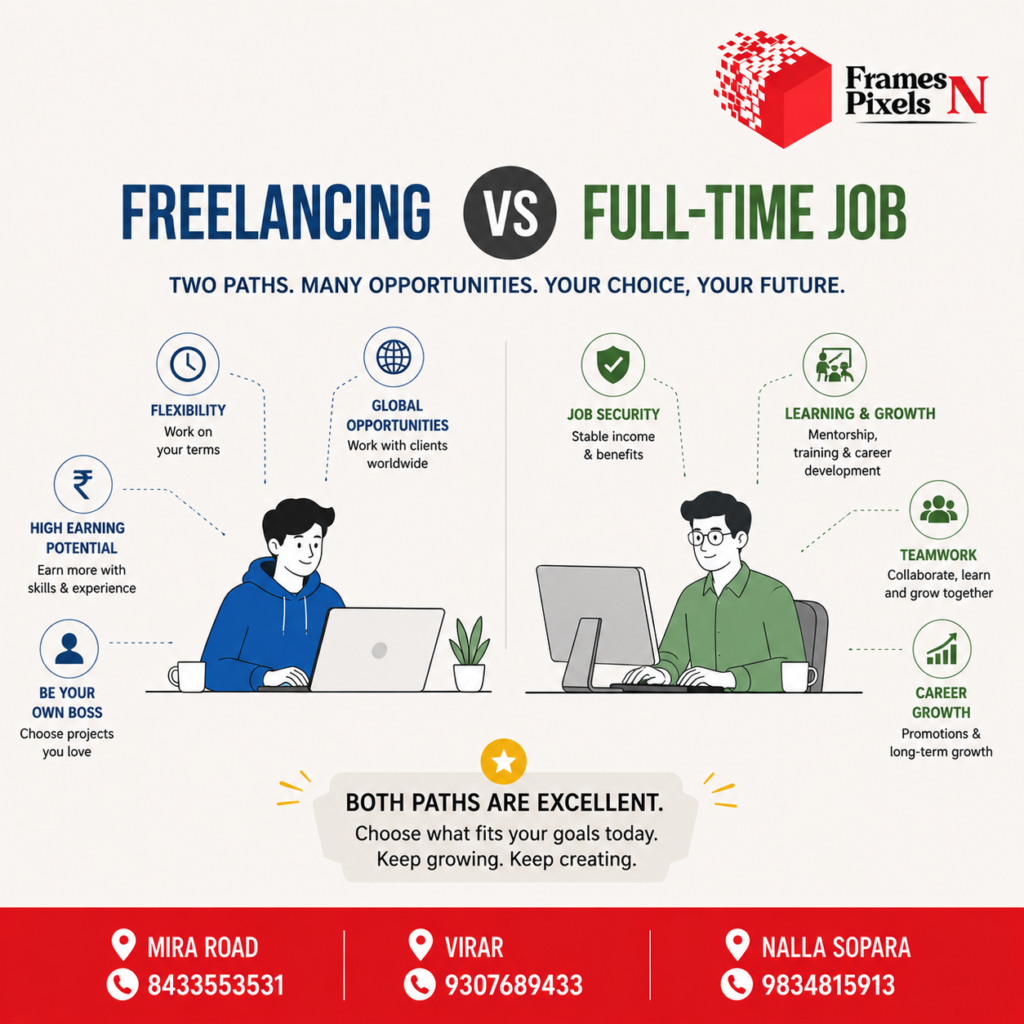
Freelancing vs Full-Time Jobs: Which One Should You Choose?
One of the biggest advantages of a career in Animation, VFX, Graphic Design, Motion Graphics, and Digital Media is that you are not limited to a traditional office job.
Unlike many professions, creative careers offer two exciting options—you can build your career as a full-time employee or work as a freelancer, serving clients from around the world.
Many students ask:
“Which option is better?”
The answer is simple: Neither is better for everyone. Each has its own advantages, challenges, and opportunities. The best choice depends on your experience, personality, financial goals, and lifestyle.
Let’s compare both career paths.
What Is a Full-Time Job?
A full-time employee works for one company on a regular salary. Depending on the role, they may also receive benefits such as paid leave, health insurance, bonuses, and professional training.
Creative professionals work in:
- Animation studios
- VFX companies
- Advertising agencies
- Gaming studios
- Design agencies
- Television networks
- OTT production houses
- Corporate marketing departments
A full-time job provides structure and stability, making it an excellent starting point for most students.
What Is Freelancing?
A freelancer works independently and takes projects from different clients instead of working for a single employer.
Freelancers may design:
- Logos
- Social media campaigns
- Brand identities
- Animation videos
- Visual effects
- Product packaging
- Motion graphics
- Website graphics
- Marketing materials
Many freelancers work from home and serve clients not only in India but across the world.
Income: Which Pays More?
This is perhaps the most common question.
Full-Time Job
Your salary is fixed every month.
You know exactly how much you will earn, making financial planning easier.
Annual appraisals and promotions may increase your income over time.
Freelancing
There is no fixed salary.
Some months may be extremely rewarding, while others may be quieter.
However, experienced freelancers with a strong reputation often earn significantly more than they would in a regular job because they can work with multiple clients at the same time.
In the beginning, a full-time job generally offers more financial stability. Over time, successful freelancers may achieve higher earning potential.
Learning and Growth
For beginners, a full-time job offers an excellent learning environment.
Working alongside experienced professionals helps you:
- Understand industry workflows
- Improve technical skills
- Meet deadlines
- Handle client feedback
- Learn teamwork
- Build confidence
Freelancers also learn continuously, but much of their growth comes through self-learning and solving real client challenges.
Job Security
A regular job usually provides more predictable income and greater stability.
Freelancers, on the other hand, need to constantly find new clients and manage their own workload. During slow periods, income may fluctuate.
This uncertainty is one reason many professionals begin with a job before transitioning to freelancing.
Freedom and Flexibility
This is where freelancing has a clear advantage.
Freelancers often choose:
- Their working hours
- Their clients
- The projects they accept
- Where they work from
Many work from home, co-working spaces, or even while travelling.
Full-time employees usually follow company schedules and office policies, although remote and hybrid work options are becoming increasingly common.
Work-Life Balance
A full-time job often has defined working hours.
Freelancers enjoy greater flexibility, but they also carry more responsibility. They must manage client communication, invoices, deadlines, revisions, and business development.
Success in freelancing requires good time management and self-discipline.
International Opportunities
The internet has transformed freelancing.
Today, a designer in India can work for clients in the USA, Canada, Europe, Australia, or the Middle East without relocating.
Many creative professionals earn in foreign currencies while working from their own homes.
This has made freelancing more attractive than ever before.
Entrepreneurship
Freelancing can also become the first step toward building a business.
Many successful animation studios, design agencies, and production houses started with one freelancer working from a small home office.
As their client base grew, they hired employees and expanded into full-fledged companies.
Freelancing develops not only creative skills but also business and client management abilities.
Which Option Is Better for Students?
For most students, beginning with a full-time job is often the wiser choice.
It provides:
- Professional experience
- Mentorship
- Industry exposure
- Financial stability
- Strong portfolio development
After gaining a few years of experience, many professionals explore freelancing as a side business or transition into it full-time.
Some continue their jobs while freelancing during evenings and weekends, gradually building a client base before making the switch.
Skills That Matter in Both Careers
Whether you choose freelancing or employment, success depends on:
- Creativity
- Communication
- Time management
- Professionalism
- Continuous learning
- Strong portfolio
- Meeting deadlines
- Understanding client requirements
These qualities often matter more than academic marks.
The Role of AI
Artificial Intelligence is changing the way creative professionals work.
AI tools can automate repetitive tasks, generate ideas, and speed up workflows.
However, clients still value professionals who understand storytelling, branding, user experience, and creative problem-solving.
Those who combine creativity with AI will have the greatest opportunities in both freelancing and employment.
Advice for Parents
Parents often ask which career path is safer.
For beginners, a structured full-time job generally offers more security and valuable industry experience. As professionals gain confidence and build a strong portfolio, freelancing can become an excellent option for additional income or entrepreneurship.
Many successful creative professionals enjoy the best of both worlds by working full-time while taking selected freelance projects.
Final Thoughts
Choosing between freelancing and a full-time job is not about finding the “better” option. It is about selecting the path that matches your current stage of life and career goals.
A full-time job offers stability, learning, mentorship, and structured growth. Freelancing provides independence, flexibility, and the potential to earn more while working with clients from around the world.
The good news is that you don’t have to choose just one forever. Many creative professionals begin with a job, build experience, and later become successful freelancers—or even start their own studios.
The creative industry offers a rare advantage: it gives you the freedom to design not only great visuals but also the career you want.
References
- World Economic Forum. The Future of Jobs Report 2025 – Highlights creativity, adaptability, and digital skills as essential for future careers.
- Ministry of Information & Broadcasting, Government of India. Realising AVGC-XR Sector Potential in India (2022) – Identifies Animation, VFX, Gaming, Comics, and XR as high-growth sectors with expanding employment opportunities.
- FICCI–EY. Stories, Scale and Impact: Unlocking India’s Media & Entertainment Economy (2026) – Documents the growth of India’s creative industries and increasing demand for skilled professionals.
- Adobe Future Workforce Study – Emphasizes the growing demand for digital creativity and design skills across industries.