When Visual Effects Should Be Seen and When They Shouldn’t
Introduction
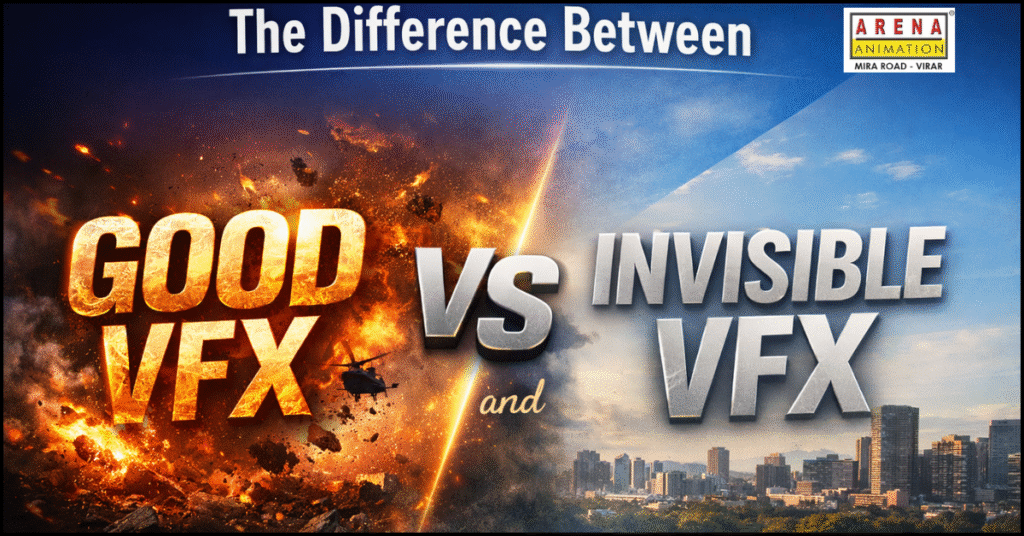
Visual Effects (VFX) often grab attention with explosions, creatures, and fantasy worlds. But some of the most impressive VFX work is the kind audiences never notice. This brings us to an important distinction every aspiring VFX artist should understand: the difference between good VFX and invisible VFX.
At Arena Animation, students are trained to appreciate both styles—and to know when each one is needed.
What Is Good VFX?
Good VFX is designed to impress, excite, and visually stand out. It’s meant to be noticed and remembered.
Examples of good VFX include:
- Superhero powers
- Sci-fi environments
- Fantasy creatures
- Large-scale destruction scenes
Here, the goal is visual spectacle and creative impact.
What Is Invisible VFX?
Invisible VFX blends seamlessly into live-action footage, making scenes feel real without drawing attention to the effect itself.
Examples include:
- Removing wires or safety rigs
- Enhancing environments
- Adding crowds or backgrounds
- Set extensions and clean-ups
Audiences don’t say, “That was great VFX.” They say, “That felt real.”
Why Invisible VFX Is Often Harder to Create
Invisible VFX requires:
- Precise lighting matching
- Realistic textures
- Accurate camera tracking
- Subtle compositing
One small mistake can break realism. This level of detail is why invisible VFX is highly valued in the industry.
At Arena Animation, students are taught compositing and realism techniques that form the backbone of professional VFX work.
🔗 Learn more about VFX training programs:
https://www.arena-multimedia.com
Good VFX vs Invisible VFX: A Simple Comparison
| Good VFX | Invisible VFX |
| Meant to stand out | Meant to blend in |
| Visually dramatic | Subtle and realistic |
| Fantasy & spectacle | Realism & believability |
| Audience notices it | Audience forgets it exists |
Both styles are essential—and mastering both makes a VFX artist industry-ready.
How Arena Animation Trains Students for Both
At Arena Animation, students learn:
- Strong VFX fundamentals
- Compositing and color correction
- Real-world project workflows
- Industry expectations and pipelines
This balanced approach ensures students can create both visually striking and realistically seamless effects.
🔗 Discover animation and VFX career paths:
https://www.arena-multimedia.com
Frequently Asked Questions (Q&A)
Q1: Is invisible VFX better than good VFX?
Not better—just different. Invisible VFX focuses on realism, while good VFX focuses on spectacle. Both are equally important.
Q2: Do beginners need to learn invisible VFX first?
Yes. Learning realism builds strong fundamentals that help in all types of VFX work.
Q3: Can invisible VFX be used in small projects?
Absolutely. Even basic clean-ups and enhancements count as invisible VFX.
Q4: Which VFX skill is more employable?
Invisible VFX skills like compositing, rotoscoping, and cleanup are highly in demand across studios.
Follow Arena Animation on Social Media
Stay updated with student projects, VFX tips, and industry insights:
- 📘 Facebook: https://www.facebook.com/people/Arena-Animation-Mira-Road-Virar/61559584420604/
- 📸 Instagram:https://www.instagram.com/arenaanimation_mv/l
- ▶️ YouTube: https://www.youtube.com/@arenaanimationvirar4423
- 💼 LinkedIn:https://www.linkedin.com/in/arena-animation-mira-road-virar-66078a1b2/