
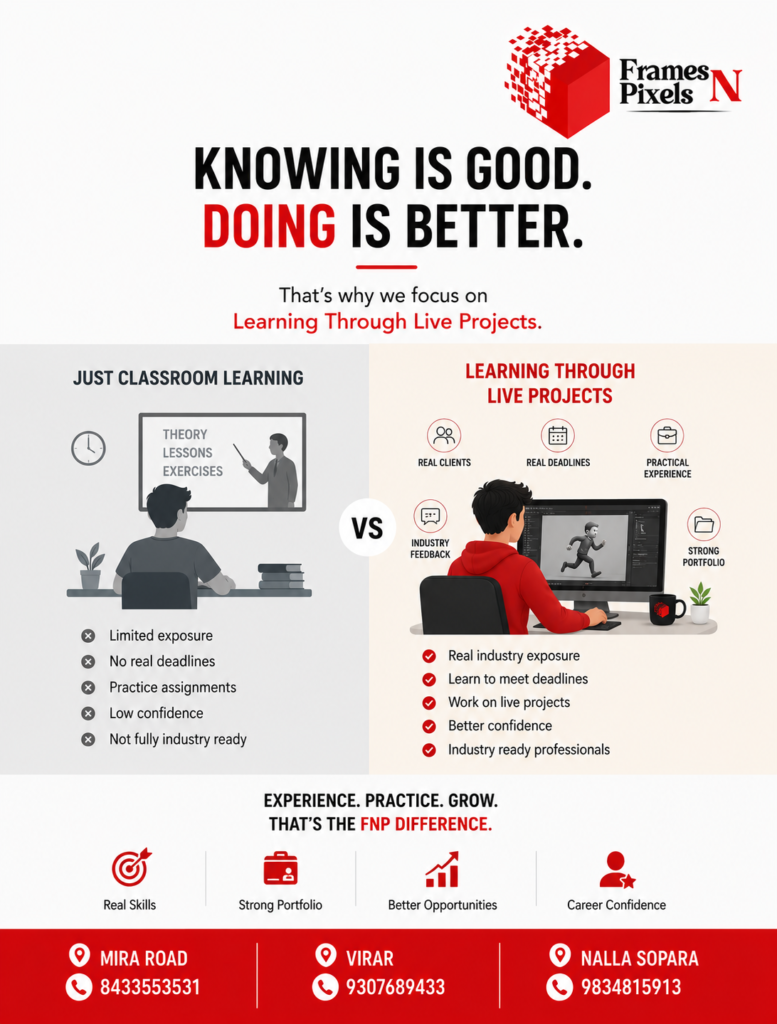
Discover why learning through live projects gives students a competitive advantage in Animation, VFX, Graphic Design, and other creative careers. Learn how industry exposure builds confidence, skills, and employability.
Learning Through Live Projects: The Difference Between Knowing and Doing
Imagine two students completing the same Animation course.
The first student has spent a year attending lectures, watching demonstrations, and completing classroom exercises.
The second student has done all of that—but has also worked on real client projects, handled deadlines, attended feedback meetings, and solved actual design challenges.
Now imagine both students appearing for the same job interview.
Which student is likely to be more confident?
Which one is better prepared for the workplace?
The answer is obvious.
In today’s skill-based industries, employers are not just looking for students who know the software. They want professionals who know how to use it in real-world situations.
That is why learning through live projects has become one of the most effective ways to prepare students for careers in Animation, VFX, Graphic Design, Motion Graphics, Video Editing, and Digital Media.
What Is a Live Project?
A live project is real work created for an actual client or an organization—not a classroom assignment.
Instead of designing an imaginary logo or creating a fictional advertisement, students work on projects that may actually be used by businesses.
These could include:
- Logo and brand identity design
- Social media campaigns
- Motion graphics videos
- Product advertisements
- Architectural walkthroughs
- 3D product animations
- Corporate presentations
- Video editing projects
- Visual effects for promotional films
The experience is completely different from completing textbook exercises.
Why Live Projects Make Better Professionals
1. You Learn to Solve Real Problems
In class, every assignment has clear instructions.
Real clients don’t work that way.
They may change their requirements, request revisions, or ask for creative alternatives.
Students learn to think, adapt, and solve problems—skills that employers value highly.
2. You Learn to Meet Deadlines
Professional work always has deadlines.
Learning to plan your time, organize tasks, and deliver work on schedule is an important career skill.
Students who experience this during training adjust much faster when they start working.
3. Feedback Makes You Better
In real projects, clients rarely approve the first version.
Students receive constructive feedback, make improvements, and understand how professional creative work evolves.
This teaches patience, flexibility, and attention to detail.
4. Teamwork Becomes Natural
Large creative projects often involve designers, animators, editors, VFX artists, and project managers working together.
Live projects teach students how to communicate, collaborate, and contribute as part of a professional team.
5. Confidence Grows
There is a huge difference between saying,
“I learned Photoshop.”
and
“I designed a campaign that was actually used by a client.”
Real experience gives students confidence during interviews and portfolio presentations.
Your Portfolio Becomes Stronger
Employers don’t just ask about qualifications.
They ask:
“Can I see your work?”
Students who have completed live projects build portfolios filled with real-world examples instead of only practice exercises.
This makes them stand out during recruitment.
Live Projects Prepare You for Freelancing
Many students dream of becoming freelancers or starting their own creative studios.
Live projects teach important business skills, including:
- Understanding client requirements
- Professional communication
- Presenting ideas
- Managing revisions
- Meeting deadlines
- Delivering final files
These experiences are difficult to learn from books alone.
Learning Beyond Software
Knowing software is important.
But successful creative professionals also need to understand:
- Branding
- Storytelling
- Design thinking
- User experience
- Marketing
- Client expectations
- Time management
- Professional ethics
Live projects naturally teach these skills because students work in situations similar to the real industry.
The Role of AI
AI tools are becoming part of creative workflows.
They help generate ideas, automate repetitive tasks, and speed up production.
However, AI cannot replace the ability to understand a client’s objectives, develop original concepts, or make creative decisions.
Students who work on live projects learn how to use AI as a productivity tool while still applying human creativity and critical thinking.
Why Frames N Pixels Is Different
Many training institutes focus mainly on teaching software.
At Frames N Pixels, students are encouraged to go a step further—they learn by creating real work.
Through industry-oriented learning, students get opportunities to participate in live projects that simulate professional working environments and, wherever possible, contribute to actual client assignments.
This approach helps students:
- Build stronger portfolios
- Gain practical experience
- Understand client expectations
- Improve communication skills
- Learn teamwork
- Develop confidence before entering the job market
Instead of simply completing a course, students graduate with practical experience that employers value.
Advice for Students
If you’re choosing an institute, don’t just ask:
“Which software will I learn?”
Also ask:
- Will I work on live projects?
- Will I build a professional portfolio?
- Will I experience real production workflows?
- Will I receive industry feedback?
- Will I graduate with practical experience?
These questions can make a significant difference to your career.
Advice for Parents
Parents often compare institutes based on fees, course duration, or infrastructure.
These are important, but another question deserves equal attention:
“Will my child gain real industry experience during the course?”
Practical exposure helps students become more confident, more employable, and better prepared for professional life.
Choosing an institute that emphasizes learning through live projects can provide a valuable advantage.
Summary
Creative careers are built through practice, experience, and continuous learning.
Software can be taught in a classroom, but professionalism is developed by working on real challenges.
Live projects bridge the gap between education and employment. They help students understand industry expectations, strengthen their portfolios, and develop the confidence to succeed in jobs, freelancing, or entrepreneurship.
At Frames N Pixels, we believe students learn best by creating, collaborating, and solving real-world problems. Our focus on live projects ensures that students don’t just earn a certificate—they build the skills, experience, and confidence needed for a successful creative career.
References
- World Economic Forum. The Future of Jobs Report 2025 – Emphasizes experiential learning, problem-solving, collaboration, and practical skills as critical for future employment. https://www.weforum.org/reports/the-future-of-jobs-report-2025/
- Ministry of Information & Broadcasting, Government of India. Realising AVGC-XR Sector Potential in India (2022) – Highlights the need for industry-ready talent and stronger academia-industry collaboration in the AVGC-XR sector. https://mib.gov.in/sites/default/files/AVGC-XR%20Task%20Force%20Report.pdf
- FICCI–EY. Stories, Scale and Impact: Unlocking India’s Media & Entertainment Economy (2026) – Notes the growing demand for professionals who can contribute immediately through practical experience. https://ficci.in/sector/media-and-entertainment
- National Education Policy (NEP) 2020 – Encourages experiential, project-based, and skill-oriented learning to improve employability. https://www.education.gov.in/sites/upload_files/mhrd/files/NEP_Final_English_0.pdf
- https://www.aicte-india.org/