
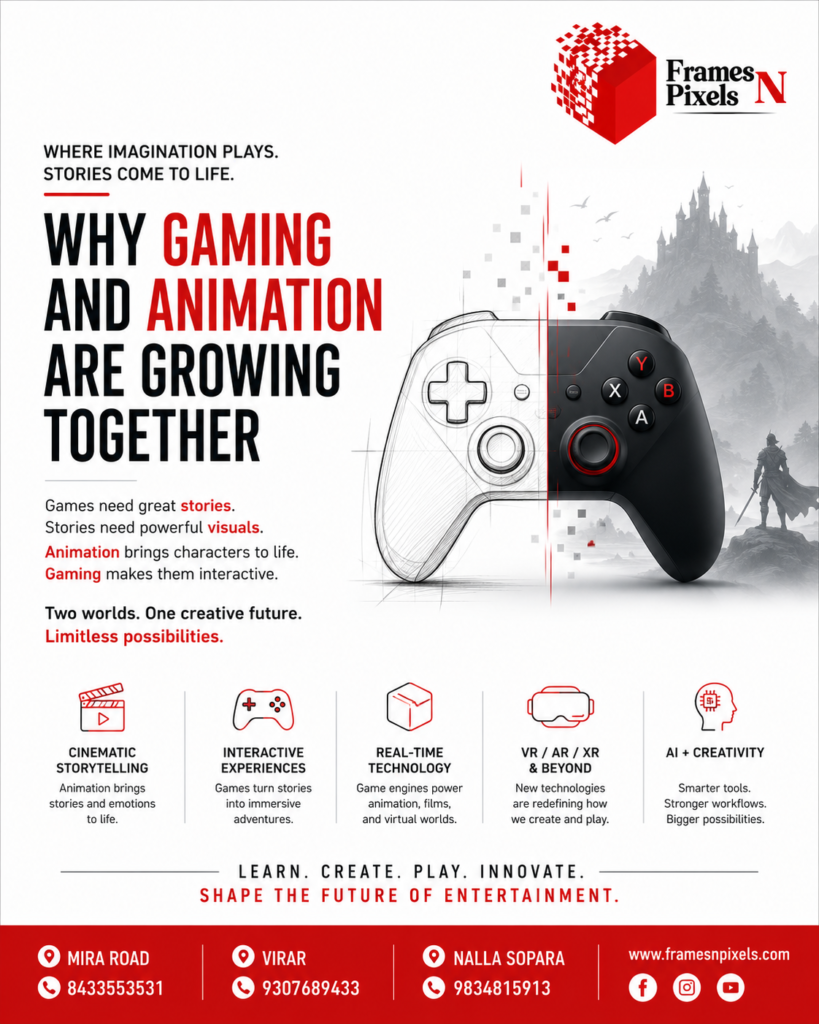
Discover why the gaming and animation industries are increasingly connected, what skills are needed, and how this growing relationship is creating exciting career opportunities for students.
Why Gaming and Animation Are Growing Together
Gaming and animation were once considered two separate creative industries. Today, the line between them is becoming increasingly blurred.
A modern video game can look like an animated film. Animated characters can appear in interactive worlds. Virtual production combines gaming technology with filmmaking, while technologies such as Virtual Reality (VR), Augmented Reality (AR), and Extended Reality (XR) are creating entirely new forms of entertainment.
This convergence is creating exciting opportunities for students interested in Animation, VFX, Gaming, 3D Design, and Digital Media.
But why are these industries growing together?
1. Games Are Becoming More Cinematic
Today’s video games are far more than simple characters moving across a screen.
Modern games feature:
- Detailed 3D environments
- Realistic characters
- Facial expressions
- Motion capture
- Cinematic storytelling
- Special effects
- Complex character animation
Game developers increasingly use techniques that were traditionally associated with animation and filmmaking.
A game’s opening sequence, for example, may look like a fully produced animated movie. During gameplay, characters must walk, run, fight, interact, and express emotions realistically.
All of this requires animation skills.
This has increased the demand for professionals who understand both game development and animation.
2. Animation Skills Are Essential in Game Development
Every game needs movement.
Characters need to walk, run, jump, fight, react, and communicate.
This is where animators play a crucial role.
A game animator may work on:
- Character movement
- Facial animation
- Creature animation
- Combat sequences
- Interactive environments
- Cinematic sequences
- Non-player character (NPC) behaviour
Unlike traditional animation, game animation must also respond to the player’s actions.
This makes game animation a specialised and exciting field.
3. Game Engines Are Changing the Creative Industry
Game engines such as Unreal Engine and Unity are no longer used only to make video games.
They are now being used in:
- Film production
- Virtual production
- Advertising
- Architecture
- Automotive design
- Training simulations
- Virtual events
- Education
This means that learning a game engine can open career opportunities beyond gaming.
For example, real-time 3D technology allows filmmakers to create virtual environments that can be displayed and changed instantly.
The same technology can also be used by architects to create interactive walkthroughs of buildings before they are constructed.
4. Virtual Production Is Bringing Film and Gaming Together
One of the most interesting developments is virtual production.
Instead of creating every environment physically, filmmakers can use real-time 3D technology to create digital backgrounds and virtual worlds.
Actors can perform in front of large LED screens displaying computer-generated environments.
This approach combines:
Animation + VFX + Game Engines + Cinematography
Professionals working in this field need knowledge of both traditional filmmaking and real-time 3D technology.
This is creating new career paths for artists and technical professionals.
5. The Rise of VR, AR and XR
Virtual Reality and Augmented Reality are creating another connection between gaming and animation.
In a traditional movie, the audience watches the story.
In a game, the player interacts with the story.
In VR and XR experiences, the user can become part of the environment.
This requires designers and artists to create:
- 3D environments
- Interactive characters
- Virtual objects
- Animation systems
- Immersive experiences
As these technologies develop, the demand for people who understand 3D animation and interactive design is likely to grow.
6. The Gaming Industry Needs More Than Programmers
Many students assume that a career in gaming means learning programming.
Programming is certainly important, but game development requires a wide range of professionals.
A gaming studio may need:
- Game programmers
- 3D modelers
- Game artists
- Character artists
- Animators
- Texture artists
- VFX artists
- Environment designers
- UI/UX designers
- Game designers
- Sound designers
- Technical artists
This makes gaming an attractive career option for students with different interests and abilities.
Someone who enjoys drawing and storytelling may find their place as a character artist or animator, while someone interested in technology may choose programming or technical art.
7. Animation and Gaming Are Both Becoming Global Careers
The digital nature of these industries means that creative professionals can work with companies and clients across the world.
A talented artist in India can contribute to a gaming project developed by an international studio.
Similarly, animation and VFX professionals can work on films, advertisements, games, and digital content for global audiences.
Remote collaboration and digital production pipelines have made geographical boundaries less important than they once were.
For students, this creates the possibility of building careers that are connected to the global creative economy.
8. Artificial Intelligence Will Change Both Industries
Artificial Intelligence is also influencing gaming and animation.
AI tools are being explored for:
- Character generation
- Concept development
- Animation assistance
- Voice generation
- Procedural content
- Environment creation
- Motion capture processing
However, AI does not eliminate the need for skilled professionals.
Someone still needs to decide what the character should look like, how it should behave, what story it should tell, and how players should experience the world.
The future professional will likely be someone who understands creative fundamentals and AI-powered tools.
9. The Skills Students Should Learn
Students interested in gaming and animation should consider developing a combination of creative and technical skills.
Useful areas include:
- Drawing and visualisation
- 3D modelling
- Texturing
- Character design
- Animation principles
- VFX
- Motion graphics
- Game engines
- UI/UX design
- Storytelling
- AI-assisted creative workflows
Learning software is important, but understanding the fundamentals is even more valuable.
Software changes.
Creative and problem-solving skills remain relevant.
10. Is This a Good Career Choice After 12th?
For students who enjoy creativity, technology, storytelling, and digital experiences, the combination of animation and gaming can offer an exciting career path.
Instead of thinking of Animation and Gaming as completely separate fields, students can look at the larger ecosystem of digital content and interactive experiences.
A student may begin with animation and later move into game development.
Another may start with VFX and enter virtual production.
Someone interested in graphic design may move into UI/UX or game interface design.
The skills often overlap, allowing professionals to explore different career directions. At Frames N Pixels students are taught both Animation and Game Development. Learn more at https://www.arenavirar.com
The Future Is About Convergence
Gaming and animation are growing together because technology is bringing different creative industries closer.
Films are becoming interactive.
Games are becoming cinematic.
Virtual production is combining filmmaking with real-time 3D.
VR and XR are creating immersive experiences.
AI is changing creative workflows.
For students, this means the opportunities are no longer limited to traditional job titles.
The most successful professionals will be those who combine creativity, technical knowledge, storytelling, and the ability to adapt to new technologies.
The future of digital entertainment is not going to be defined by one industry alone.
It will be created at the intersection of Animation, Gaming, VFX, AI, and immersive technology.
And for young people who enjoy both creativity and technology, that intersection could be one of the most exciting places to build a career.
References
- Ministry of Information & Broadcasting, Government of India – AVGC-XR Sector
Provides information on India’s Animation, Visual Effects, Gaming and Extended Reality ecosystem, including industry growth, education and skill development.
AVGC-XR Sector – Ministry of Information & Broadcasting - AVGC Promotion Task Force Report – Government of India
A detailed report covering the global and Indian AVGC sector, including gaming, animation, skill development, education and technology.
Realising AVGC-XR Sector Potential in India – Government Report - Unreal Engine – What Is Virtual Production?
Explains how real-time game engines are bringing together gaming technology, animation, filmmaking, VFX and virtual production.
What Is Virtual Production? – Unreal Engine - Unreal Engine – Features
Details how modern game engines support characters, animation, visual effects, world building, interactive experiences, VR, AR and virtual production.
Unreal Engine Features - Unreal Engine – Extended Reality (XR)
Provides information about the use of real-time technology in VR, AR and MR, including applications in gaming, filmmaking and photorealistic visualisation.
Unreal Engine for Extended Reality (XR) - Ministry of Information & Broadcasting – Indian Institute of Creative Technologies (IICT)
Information about India’s National Centre of Excellence initiative for Animation, Gaming and Special Effects and the development of talent for the AVGC-XR sector.
Indian Institute of Creative Technologies (IICT) – Ministry of Information & Broadcasting